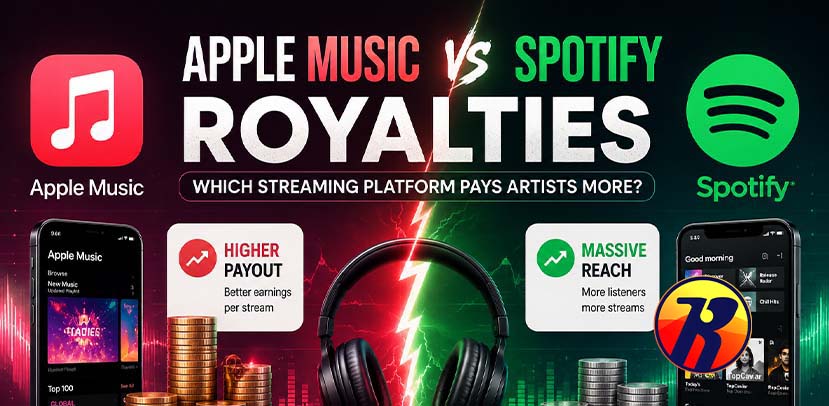
The debate around Apple Music royalties vs Spotify has become one of the biggest discussions in the music industry. As streaming continues to dominate music consumption worldwide, artists, record labels, distributors, and independent musicians want to know which platform offers better earnings. While both Apple Music and Spotify have millions of subscribers and extensive global reach, their royalty systems differ significantly.
Understanding how each platform calculates payouts can help artists develop smarter release strategies and maximize revenue from their music.
Understanding Music Streaming Royalties
Music streaming royalties are payments made to rights holders whenever a song is streamed on a digital platform. These payments are usually divided among record labels, distributors, publishers, songwriters, and performing artists.
Contrary to popular belief, streaming platforms do not pay artists a fixed amount per stream. Instead, payouts depend on several factors, including:
- Subscription revenue
- Advertising revenue
- Total number of streams
- Country where the stream occurred
- Listener subscription type
- Licensing agreements
- Distribution fees
This means that two streams from different countries or subscription plans may generate different royalty amounts.
How Spotify Royalties Work
Spotify operates using a pro-rata royalty model. The company pools all subscription and advertising revenue, keeps a percentage for operational costs, and distributes the remaining revenue to rights holders based on each artist’s share of total streams.
For example, if an artist accounts for 1% of all streams during a payment period, that artist receives approximately 1% of the royalty pool allocated to rights holders.
Spotify’s payout is affected by:
- Premium versus free users
- Geographic location
- Currency exchange rates
- Total monthly streams
- Distribution agreements
Because Spotify has a large free tier supported by advertisements, its average royalty rate tends to be lower than premium-only platforms.
How Apple Music Royalties Work
Apple Music follows a different business model. Unlike Spotify, Apple Music does not offer a free ad-supported listening option. Every listener is a paying subscriber.
Since nearly all revenue comes from subscriptions, Apple Music generally pays higher royalties per stream.
Apple states that it pays royalties based on:
- Individual subscriber revenue
- Subscription location
- Licensing agreements
- Rights ownership
- Music consumption
Although Apple also uses revenue pooling, the absence of free users allows a greater portion of revenue to be distributed to rights holders.
Apple Music Royalties vs Spotify Per Stream
While exact royalty rates change regularly and vary by country, industry estimates provide a useful comparison.
| Platform | Estimated Average Per Stream |
|---|---|
| Apple Music | $0.006–$0.01 |
| Spotify | $0.003–$0.005 |
These figures are averages rather than guaranteed rates. Actual payouts vary depending on many factors.
Based on current industry estimates, Apple Music generally pays nearly twice as much per stream as Spotify.
Why Apple Music Usually Pays More
Several reasons explain Apple’s higher average royalty rate.
No Free Tier
Every Apple Music listener is a paying subscriber. Spotify’s free users generate less advertising revenue than premium subscribers, reducing the average payout per stream.
Higher Subscription Revenue
Apple Music’s revenue comes almost entirely from monthly subscriptions, resulting in a larger royalty pool.
Smaller Stream Volume
Spotify records significantly more total streams than Apple Music. Since the royalty pool is divided across more streams, the average value per stream becomes lower.
Spotify’s Biggest Advantage
Although Spotify pays less per stream, it remains the world’s largest music streaming platform.
Benefits include:
- Largest global audience
- Excellent music discovery features
- Personalized playlists
- Viral algorithmic recommendations
- Spotify Radio
- Discover Weekly
- Release Radar
- Editorial playlists
- Podcast integration
Many independent artists receive their first major exposure through Spotify’s recommendation engine.
Apple Music’s Biggest Advantage
Apple Music focuses more on premium listening experiences and editorial curation.
Advantages include:
- Higher royalty rates
- Lossless audio
- Spatial Audio
- Better earnings per listener
- Strong editorial playlist placements
- Integration across Apple devices
- High-value subscriber base
Artists with loyal audiences often generate more revenue from Apple Music than from the same number of Spotify streams.
Example Royalty Comparison
Suppose an independent artist receives 1 million streams.
Estimated Spotify earnings:
- Approximately $3,000–$5,000 before distributor and label deductions
Estimated Apple Music earnings:
- Approximately $6,000–$10,000 before deductions
Actual earnings vary depending on listener location, subscription types, and contractual agreements.
Which Platform Has More Users?
Spotify has a considerably larger user base than Apple Music.
Spotify offers:
- Free listening
- Premium subscriptions
- More global market penetration
- Wider playlist ecosystem
Apple Music has fewer subscribers but generally generates more revenue per individual listener.
For many artists, higher Spotify stream counts compensate for its lower payout rate.
Do Independent Artists Earn More?
Independent musicians often keep a larger share of streaming income because they own their masters.
When distributing through services such as TuneCore, DistroKid, CD Baby, Redlamp Music Managers, or similar distributors, artists can receive a substantial portion of royalties after distribution fees.
The amount retained depends on:
- Distribution agreement
- Publishing ownership
- Record label contracts
- Collection society registrations
- Mechanical royalties
- Performance royalties
Owning both the master recording and publishing rights can significantly increase total earnings.
Beyond Streaming Royalties
Streaming income should be viewed as one part of a broader music business strategy. Successful artists often combine royalties with multiple revenue sources, including:
- Live performances
- Merchandise sales
- Brand partnerships
- YouTube monetization
- Sync licensing
- Publishing royalties
- Fan memberships
- Digital downloads
- Vinyl and physical sales
- Crowdfunding
Diversifying income streams creates greater financial stability than relying on streaming alone.
Tips to Maximize Streaming Revenue
Artists can improve their earnings by following best practices such as:
- Release music consistently to maintain listener engagement.
- Submit songs for editorial and independent playlist consideration.
- Build a loyal fan base that streams music repeatedly.
- Encourage listeners to save songs and follow artist profiles.
- Promote releases across social media platforms.
- Register songs with performing rights organizations and publishing administrators.
- Ensure all metadata is accurate before distribution.
- Analyze streaming data to identify high-performing markets and target promotional efforts.
Apple Music vs Spotify: Which Is Better for Artists?
The answer depends on your goals.
If your priority is higher earnings per stream, Apple Music generally offers better royalty rates. Artists with dedicated fan bases may generate more revenue from Apple Music because every listener is a paying subscriber.
If your priority is maximum exposure and audience growth, Spotify remains difficult to beat. Its recommendation algorithms, playlists, and massive global user base provide opportunities for music discovery that can lead to significant long-term growth.
Most successful artists distribute their music to both platforms. This approach combines Spotify’s unmatched reach with Apple Music’s stronger average payouts, allowing artists to expand their audience while maximizing revenue potential.
Frequently Asked Questions
Does Apple Music pay more than Spotify?
Yes. On average, Apple Music pays a higher royalty per stream than Spotify, although the exact amount varies based on factors such as listener location, subscription type, and licensing agreements.
How much does Spotify pay per 1,000 streams?
Average estimates range from $3 to $5 per 1,000 streams before distributor, publisher, or label deductions.
How much does Apple Music pay per 1,000 streams?
Industry estimates suggest approximately $6 to $10 per 1,000 streams, though actual payouts vary.
Should independent artists prioritize Apple Music?
Independent artists should distribute to both Apple Music and Spotify. Apple Music can provide stronger earnings per stream, while Spotify offers greater opportunities for discovery and audience growth.
Final Thoughts
When comparing Apple Music royalties vs Spotify, Apple Music generally delivers higher payouts per stream, making it attractive for artists focused on maximizing revenue from existing fans. Spotify, however, remains the dominant platform for music discovery, playlist exposure, and global audience reach.
Rather than choosing one platform over the other, the most effective strategy is to make your music available everywhere your audience listens. By combining strong distribution, strategic marketing, and consistent releases, artists can build sustainable streaming income while expanding their careers across the world’s leading music platforms.